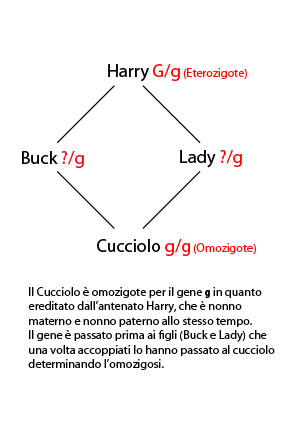
Each dog’s profile contains a numerical value, the COI (Coefficient of Ibreeding, or Wright Coefficient, but more commonly known as the Coefficient of Inbreeding), which is expressed as a percentage. This coefficient is a tool for estimating a dog’s inbreeding (the degree of homozygosity) and can provide some indication of the probability of transmitting one or more characteristics; simulating the resulting COI between two hypothetical breeders is essential for accurately evaluating a mating. What are the principles on which this tool is based? The calculation of this coefficient is based on a very simple biological foundation: a child receives exactly half its genetic makeup from the father and half from the mother, and with each subsequent generation the genes passed on are halved. Based on this assumption, when common ancestors exist in a dog’s genealogy, their genetic makeup occurs twice or more. This increases the probability that a gene in a dog will be paired with its homologue, that is, the same allele, inherited from the same common ancestor of the parents, producing a state of homozygosity for that gene. A practical example can better illustrate the concept:
| Buck | Harry |
| July | |
| Lady | Harry |
| Ana |
Both parents, Buck and Lady, may have received the same g gene from Harry, who is heterozygous for G/g. The puppy can therefore be homozygous for the gene (g/g) due to the parents’ common ancestor, Harry, with a certain probability.
This probability, relative to any gene in the puppy, constitutes its inbreeding coefficient (or consanguinity). This probability can also be understood as the fraction of homozygous genes by common descent present in the puppy’s genome overall. For example, a 10% consanguinity means that the probability of any single gene being homozygous by Mendelian descent is 1 in 10, but at the same time that 10% of its genes, compared to its entire genome, are homozygous by Mendelian descent. It is important to note that the same g gene can also be inherited because it is very common in the population of a breed, and therefore also from two unrelated ancestors. But the Inbreeding Coefficient refers exclusively to genes inherited through common ancestry.
How can we evaluate the COI figure in relation to commonly known kinship relationships? Let’s look at some practical examples with pedigrees, and everything will become clearer and more intuitive.
Sibling mating: COI 25%
The common ancestors are all the grandparents of the future puppy, whose parents share 50% of their genetic makeup. Mating halves this portion, and therefore the probability of homozygosity in the offspring is 25%.

Mating between Parent and Offspring: 25% COI
In this example, the common ancestor is B, who will be the mother of the litter, but is also the mother of its mate. Offspring A certainly possesses 50% of mother B’s genes. By mating, mother and offspring contribute half their genes, so the probability of homozygosity is halved to 25%.

Mating between grandfather and grandson: COI 12.5%
Compared to the previous example, the portion of genes from common ancestor B is halved, as there is one additional generation of separation.

Mating between half-sibs: COI 12.5%
In this example, the common ancestor is grandsire C, meaning the future puppy’s parents, A and B, share a mother and are therefore half-siblings or half-siblings.

Mating with ancestor in 2nd and 3rd generations: COI 6.25%
In this example, the common ancestor E, the father and grandfather of the litter’s parents, respectively.

Fonte Web https://www.clubsitalianocanidirazza.com/single-post/cosa-%C3%A8-il-coi